John Rasic - Soil Healer and Advisor
Expert insights for sustainable land management solutions.
John Rasic - Soil Healer and Advisor
Expert insights for sustainable land management solutions.
Signed in as:
filler@godaddy.com
Expert insights for sustainable land management solutions.

John is a soil enthusiast with more than 45 years of field experience, having examined thousands of soil profiles and surveyed around 3 million hectares across 55 countries.
His approach is simple: prove it in the field. Technology can assist, but the soil profile is the truth. Gadgets may change, but 2 × 2 still equals 4. Instruments must be calibrated to the soil - not the other way around.
John is focused on practical solutions that turn complex soil problems into productive, income-generating land use. That is the core of our service: real soil data, collected on your land, not remotely, not by AI, and not by copy-and-paste assumptions from publications that have no direct relationship to your land.
His motto says it best: Soil does not respond to opinions; it responds to how we manage it. Spare me the rhetoric - prove it in practice.


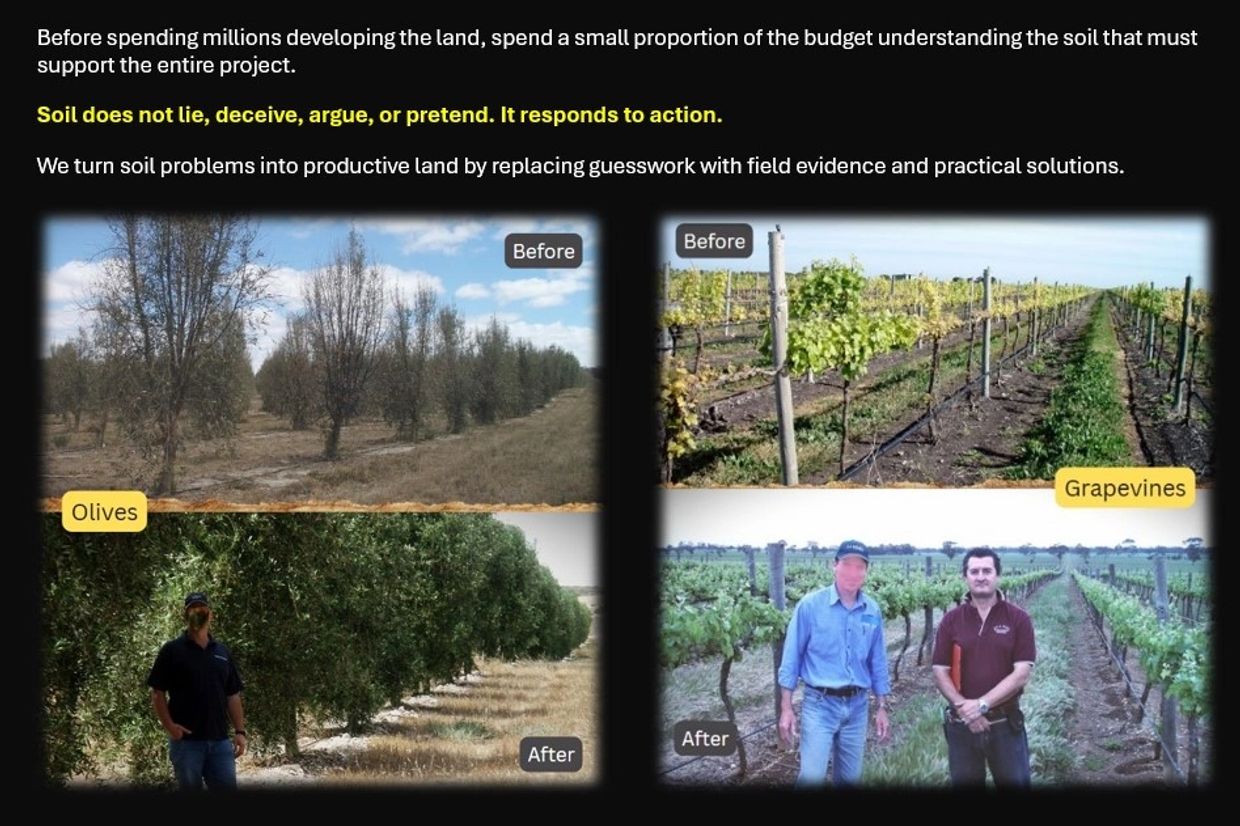
" We brought in John and we did a pit every two and a half acres. And we analyzed those pits, made a detailed soil survey map, and then went through with a restoration project over the last year, and this is the result of what you're seeing right now. It's fantastic"
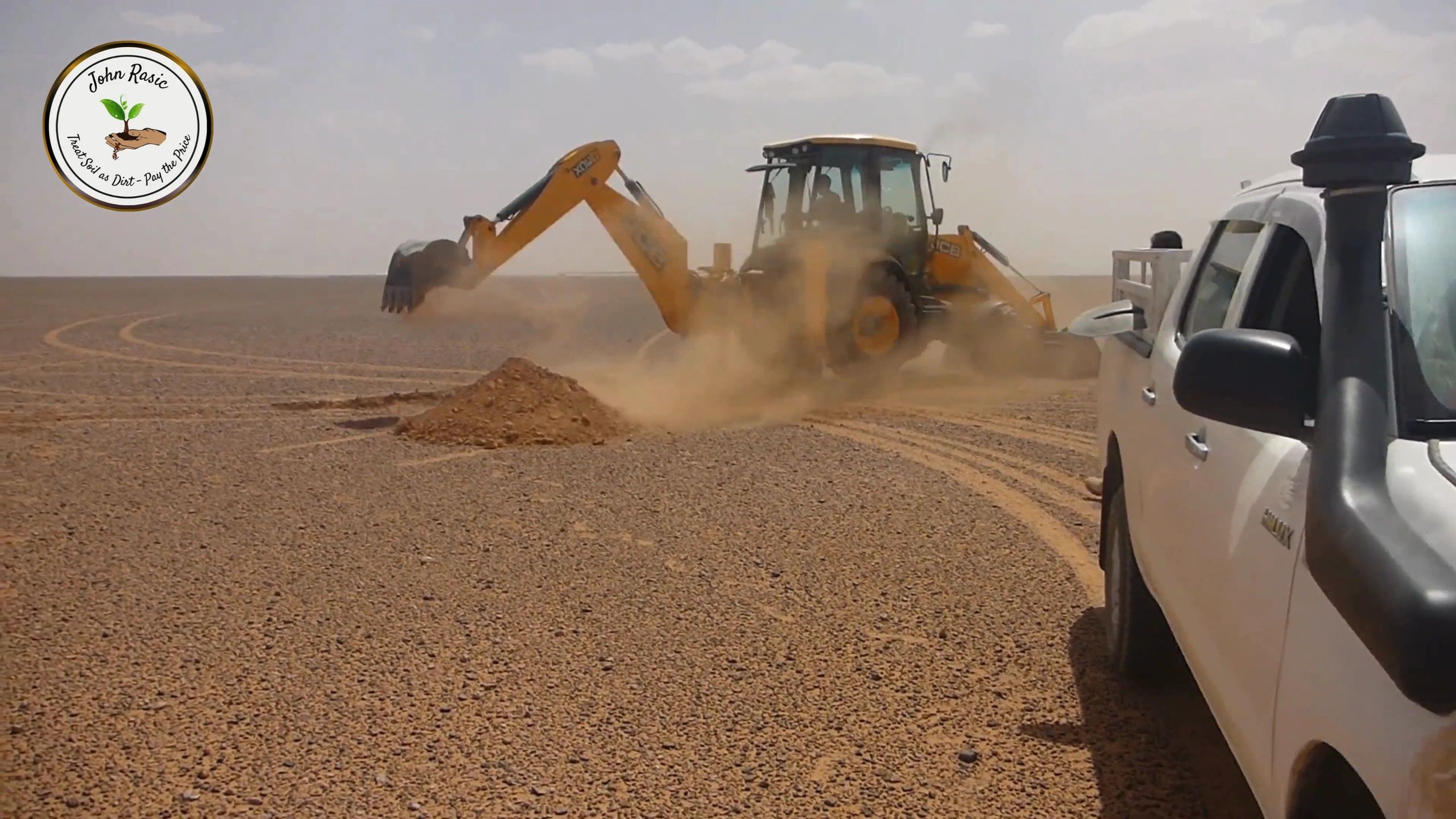
Soil begins at the surface and is measured downward. Every project stands or falls on the soil beneath it. Your soil holds the answers. We dig for them because soil does not lie. People do.

We are in the commercial soil surveying business. Our purpose is simple: to replace guesswork with evidence, reduce preventable losses, help clients invest in the right soils, and manage land according to what it can genuinely support.
Our maps and reports translate field evidence into plain language for practical decisions. They are not produced to sit on a shelf. They are designed to help clients avoid costly mistakes and make the right decisions before large sums of money are committed.
Your soil already holds the answers. We dig, examine, map, and interpret them through our four-step mapping system.
John Rasic’s four-step mapping system was not created in an office, nor from empty rhetoric, glossy brochures, or publications that have little practical connection to the land being assessed. It was shaped through years of consultation with farmers, growers, ranchers, and land managers who needed clear, practical answers based on their own soils.
John is deeply grateful to those land users who shared their experience, questions, frustrations, and practical needs. Their input helped shape a mapping system built around real field evidence, not remote assumptions, not AI, and not copy-and-paste conclusions from unrelated publications.
The purpose of the four-step mapping approach is not to make promises. It is to reduce uncertainty, lower avoidable risk, and help clients spend their money wisely from the beginning. The savings are not only in avoiding poor investments. They are also directing money towards the soils most capable of paying it back. Nothing is more expensive than developing the wrong soil based on a map or report unsupported by proper field investigation.
Our work is designed to prevent that from happening.

We determine what soils are present and where they occur.

We identify the limitations that may affect production, irrigation, development and profitability.

We show what can be corrected, improved or managed, and where treatment is required.

We identify the land’s potential after improvement and help clients decide where to invest, what to grow, and which areas require caution.

Basic soil properties, such as morphology, stratification, texture, parent material, and soil depth, can remain relevant for centuries, or even millennia. Dynamic properties, such as compaction, fertility, salinity, permeability, and biological activity, are more strongly influenced by land use and management, and should be reviewed more regularly.
This is why a four-step mapping approach is not a short-term document. When properly conducted, it becomes a long-term foundation for land use planning, investment, and management decisions. It is a once-in-a-lifetime investment in soil knowledge that can outlive any project and pay for itself many times over.

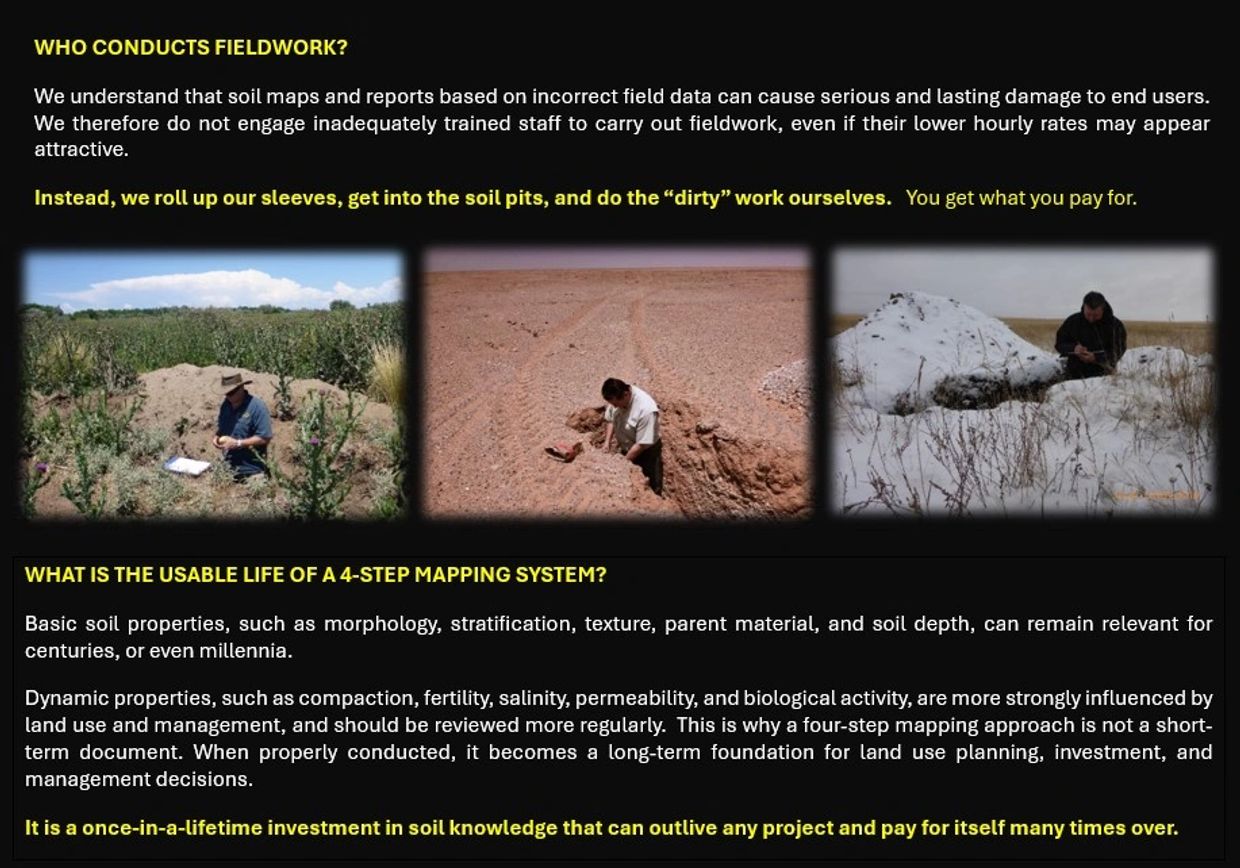
We understand that soil maps and reports based on incorrect field data can cause serious and lasting damage to end users. We therefore do not engage inadequately trained staff to carry out fieldwork, even if their lower hourly rates may appear attractive.
Instead, we roll up our sleeves, get into the soil pits, and do the “dirty” work ourselves. You get what you pay for.

A soil survey by soil profiling can have a usable life of 100 to 200 years or more. Basic soil properties, such as morphology, stratification, texture, cracking, and related features, can remain relevant for centuries or even millennia, and be used and reused countless times without the need to repeat the fieldwork.
In contrast, dynamic properties such as compaction, smearing, fertility, and permeability are more dependent on land management and should be reviewed more frequently.
Every project is different, so a standard template cannot be applied. As a rule, the more detailed the soil survey and mapping, the greater the effort required in field data collection, interpretation, mapping, and reporting. Greater detail provides greater accuracy, usefulness, and practical value, but it also requires more time and investment.
We provide both preliminary and detailed soil surveys, depending on the purpose, scale, and level of risk involved. In most cases, our detailed soil survey costs around 1% of the total project setup cost, or less.
That 1% can protect the remaining 99%. It is a small cost before a major investment.
Compared with the cost of irrigation systems, land preparation, pump stations, dams, power lines, canals, machinery, and other major infrastructure, a detailed soil survey is a minor fraction of the total investment.

A Small Cost Before a Major Investment
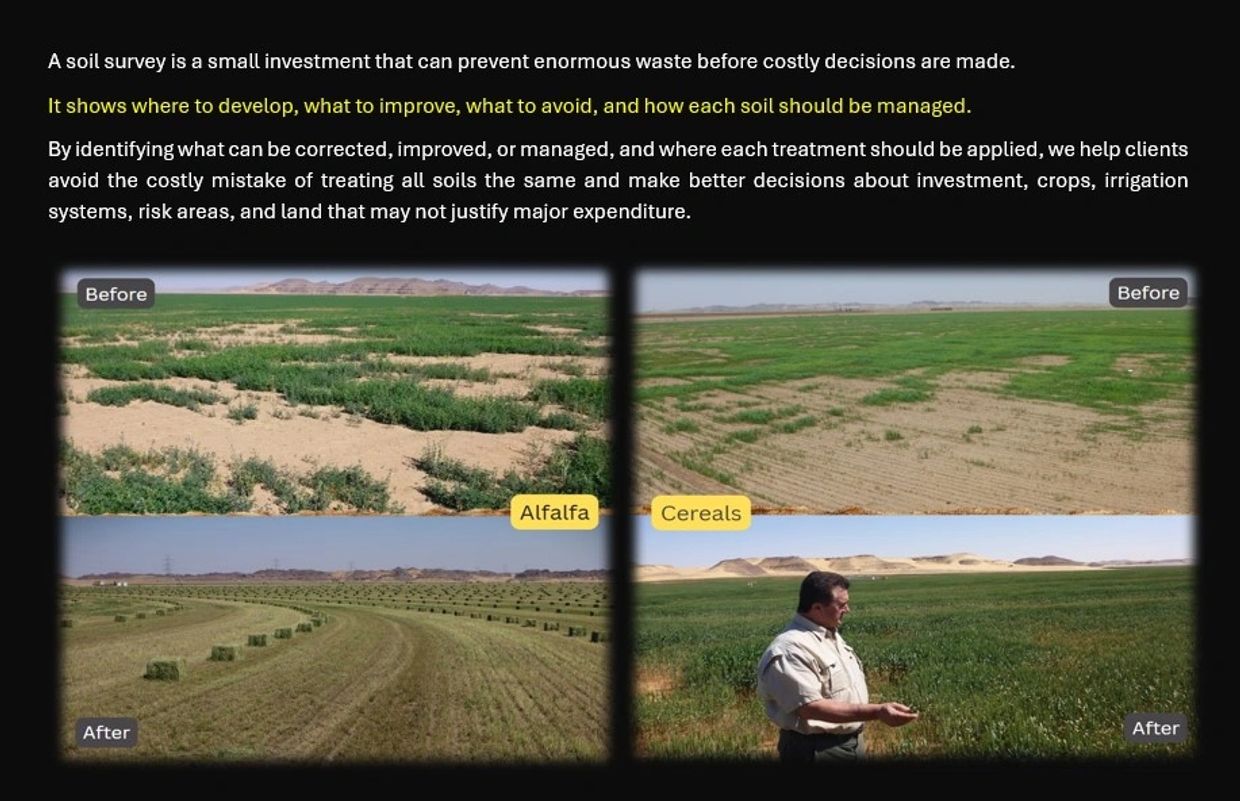
Agricultural development often demands substantial upfront capital and years of ongoing operating costs. If the soil is unsuitable or its limitations are not properly understood, money can continue to be spent while production and profit fall short of expectations. No amount of infrastructure, technology, or management can fully overcome the wrong soil in the wrong place.
A proper soil survey helps show where investment is justified, and which areas may be better left alone. That is why soil investigation should come before final design, irrigation installation, planting, and any major commitment of money.

The main benefit of our 4-step soil survey mapping system is simple: it helps clients invest in the right soils, for the right purpose, in the right way. Unlike infrastructure, our survey is based on soil profiling, which is not subject to wear and tear. It is not directly affected by changes in climate, markets, pests, diseases, water availability, fertiliser prices, machinery, labour, or chemical inputs. The land may be managed differently over time, but the soil profile remains the foundation of what that land can realistically support.
Our 4-step mapping system is a once-in-a-lifetime investment in soil knowledge. It can outlive any single project and pay for itself many times over by reducing risk, preventing waste, and directing investment towards the soils most capable of delivering a return. Worldwide experience has shown cost-benefit ratios ranging from 1:200 to 1:500 and more. If you already have a soil survey, use it wisely. If not, we can prepare one for you, because it is as important to the success of a land-based enterprise as the foundation is to a skyscraper.

John Rasic’s experience includes some of the world’s largest soil survey, land evaluations, and agricultural development projects, where mistakes are expensive. These projects required practical field investigation, mega-scale soil interpretation, mapping, and clear recommendations for development, helping protect major investments from the ground up.

Countries Where John Has Worked
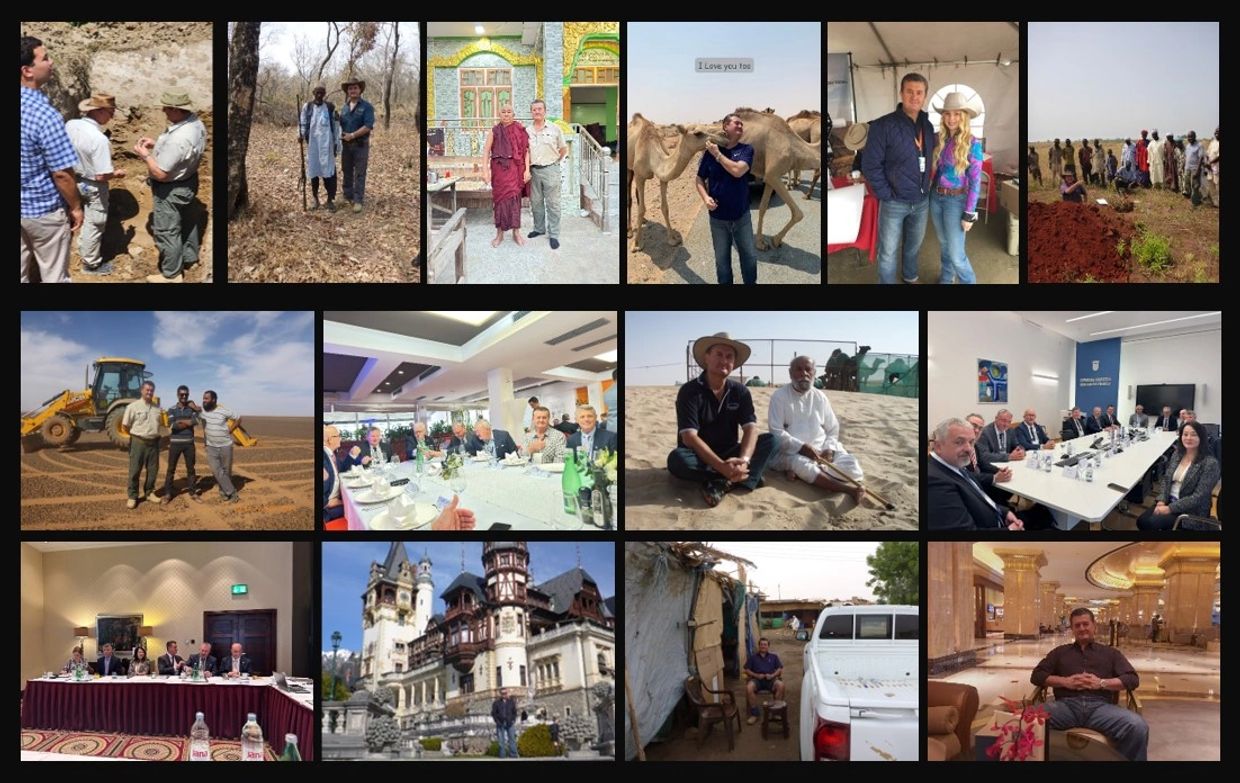
Algeria, Angola, Argentina, Australia, Azerbaijan, Bosnia and Herzegovina, Brazil, Bulgaria, Cambodia, Chile, Republic of the Congo, Croatia, Democratic Republic of the Congo, Egypt, Eritrea, Ethiopia, Georgia, Gabon, Iraq, Kazakhstan, Kenya, Kyrgyzstan, Liberia, Libya, Mali, Mauritania, Mexico, Mongolia, Morocco, Myanmar, Namibia, New Zealand, Nigeria, North Macedonia, Oman, Qatar, Romania, Russia, Saudi Arabia, Senegal, Serbia, South Sudan, Sudan, Tajikistan, Tanzania, Tunisia, Turkmenistan, Uganda, Ukraine, United Arab Emirates, United States, Uzbekistan, Vanuatu, Vietnam, and Zambia.

Selected project experience includes:

John’s experience speaks for itself:
practical results, a straightforward approach, and a strong track record of transforming difficult land into valuable, productive resources. He provides expert guidance in:
- Soil science, - Irrigation, -Land reclamation, Soil improvement and Agricultural development across a wide range of environments
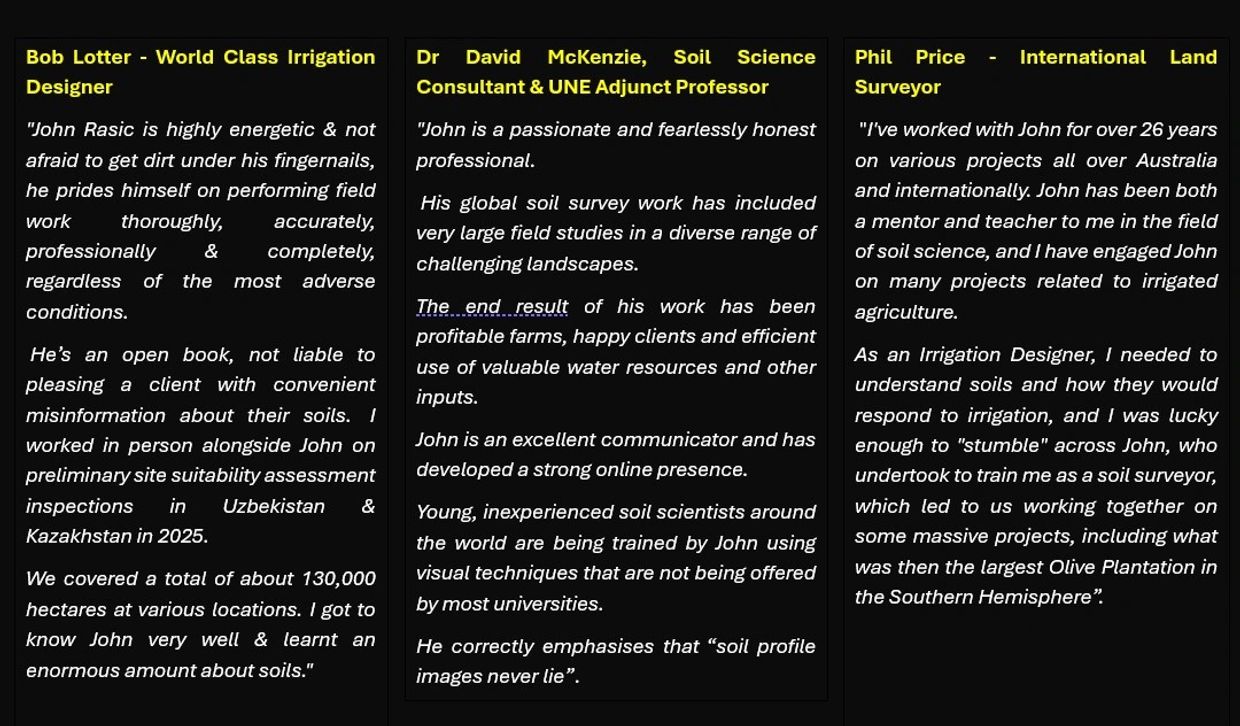
"John Rasic is highly energetic & not afraid to get dirt under his fingernails, he prides himself on performing field work thoroughly, accurately, professionally & completely, regardless of the most adverse conditions. He’s an open book, not liable to pleasing a client with convenient misinformation about their soils. I worked in person alongside John on preliminary site suitability assessment inspections in Uzbekistan & Kazakhistan in 2025. We covered a total of about 130,000 hectares at various locations over a three week period. I got to know John very well & learnt an enormous amount about soils."
"John is a passionate and fearlessly honest professional. His global soil survey work has included very large field studies in a diverse range of challenging landscapes. The end result of his work has been profitable farms, happy clients and efficient use of valuable water resources and other inputs.
John is an excellent communicator and has developed a strong online presence. Young inexperienced soil scientists around the world are being trained by John using visual techniques that are not being offered by most universities.
He correctly emphasises that “soil profile images never lie.”
"I've worked with John for over 26 years on various projects all over Australia and internationally. John has been both a mentor and teacher to me in the field of soil science and I have engaged John on many projects related to irrigated agriculture. As an Irrigation Designer I needed to understand soils and how they would respond to irrigation and I was lucky enough to "stumble" across John who undertook to train me as a soil surveyor which led to us working together on some massive projects including what was then the largest Olive Plantation in the Southern Hemisphere."

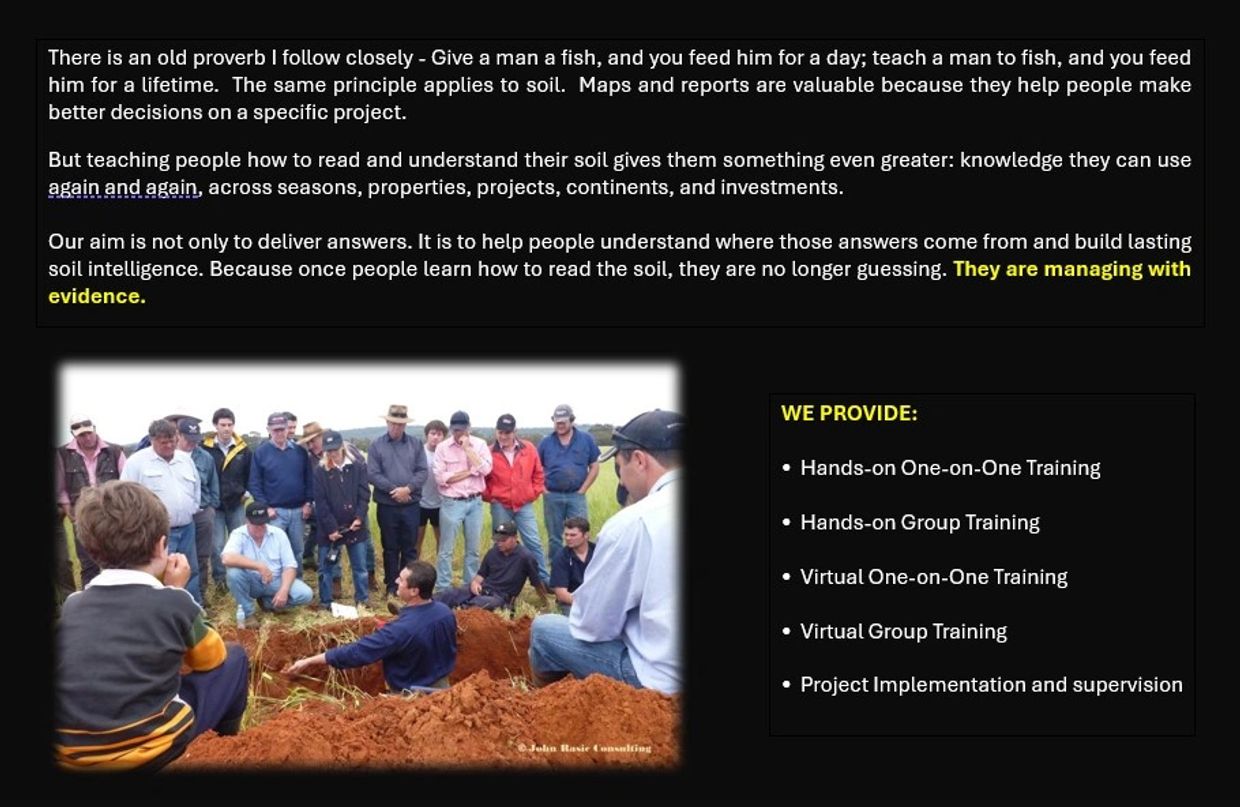
There is an old proverb I follow closely - Give a man a fish, and you feed him for a day; teach a man to fish, and you feed him for a lifetime - The same principle applies to soil.
Maps and reports are valuable because they help people make better decisions on a specific project. But teaching people how to read and understand their soil gives them something even greater: knowledge they can use again and again, across seasons, properties, projects, continents, and investments.
Our aim is not only to deliver answers. It is to help people understand where those answers come from and build lasting soil intelligence. Because once people learn how to read the soil, they are no longer guessing. They are managing with evidence.
We provide:
• Hands-on One-on-One Training
• Hands-on Group Training
• Virtual One-on-One Training
• Virtual Group Training
• Project Implementation and Supervision
• Management, Monitoring, and Benchmarking


According to holy scripture, God created Adam from the dust of the Earth. He did not hand him a phone, a remote-control gadget, an air-conditioned office, or a Ferrari. He placed him in the Garden of Eden to cultivate and irrigate the land. That tells us something. Soil, water, food, and land management are not modern inventions. They are among the oldest responsibilities of humanity. Yet, after all these millennia, it is astonishing how little many people truly understand them. To drive a car, teach a class, or operate machinery, you need basic training. But to manage land - the very foundation of food production and life itself - too often, anyone can pretend to be an expert. That is where charlatanism becomes dangerous. In soil and irrigation, fake expertise does not just produce bad advice. It destroys land, pollutes the environment, wastes money, and damages the future.
Why do we dig ?. Ultimately we must look beneath the surface and this will tell the real story. To fully understand the land and its composition can only happen when we look below.
Sustainable use and management of muddy soils are challenging across agriculture, landscaping, construction, and infrastructure. Each site and project brings its own problems, which is why copy-and-paste solutions do not work. In many cases, they can make the problem worse.
Muddy soils must be understood before they are managed. Generalising is illogical because one size never fits all. What fascinates me most is watching how muddy soils form - it is soil history in the making

John Rasic is not just a soil consultant; he is a soil healer. With a unique background that bridges old-world agricultural wisdom from his childhood with rigorous scientific training from the University of Novi Sad and Soviet-era research institutions, he brings a perspective that is simply unmatched in the field. He understands that s
John Rasic is not just a soil consultant; he is a soil healer. With a unique background that bridges old-world agricultural wisdom from his childhood with rigorous scientific training from the University of Novi Sad and Soviet-era research institutions, he brings a perspective that is simply unmatched in the field. He understands that soil is the mother of all life, and that by healing the soil, we can create resilient, productive, and profitable agricultural systems.
Please feel free to send me a message or ask me a general question.
I will do my best to get back to you soon!
Adelaide, South Australia , Australia
John Rasic - Managing Director johnrasic@outlook.com +61.423648433 James Fantasia - Glasnost Consultants / Business Director +61 418831591 james@glasnostconsultants.com.au
Open today | 09:00 – 17:00 |
Please reach us at johnirasic@gmail.com if you cannot find an answer to your question.
While traditional soil science often relies on remote sensing and surface data, John’s "Soil Healer" approach focuses on direct interaction. He believes that soil responds to human actions and reflects how it is nurtured. His methodology involves "reading" soil profiles like books, digging, smelling, and touching the earth to diagnose problems at their root rather than applying "shortcuts" or chemical "tricks."
John provides high-quality technical data to guide rational decision-making through four core pillars:
Soil Surveys: Comprehensive inventories to determine the location and extent of different soils, providing a foundation for any land-use project.
Soil Mapping: Visual summaries of soil knowledge tailored to specific scales and purposes.
Soil Services: Expert guidance on land acquisition, remediation, amelioration, and whole-farm planning.
Soil Support: Ongoing management and advisory after the initial survey to ensure sustainable, long-term success.
John is a dedicated mentor and educator who shares his 45 years of global experience across 49 countries. He offers guidance to growers, investors, and agricultural professionals through his Youtube channel and direct advisory roles. His goal is to teach others how to interpret soil information so they can manage their land independently and sustainably.
Independence is at the heart of John's work. Unlike advisors who may be influenced by commercial biases toward specific fertilizers or chemicals, John’s recommendations are based strictly on what the soil profile reveals. As noted by industry leaders like Dr David McKenzie, John provides "fearlessly honest" and "diligent" information, ensuring your land management strategy is based on truth and long-term economic health.
We use cookies to analyze website traffic and optimize your website experience. By accepting our use of cookies, your data will be aggregated with all other user data.